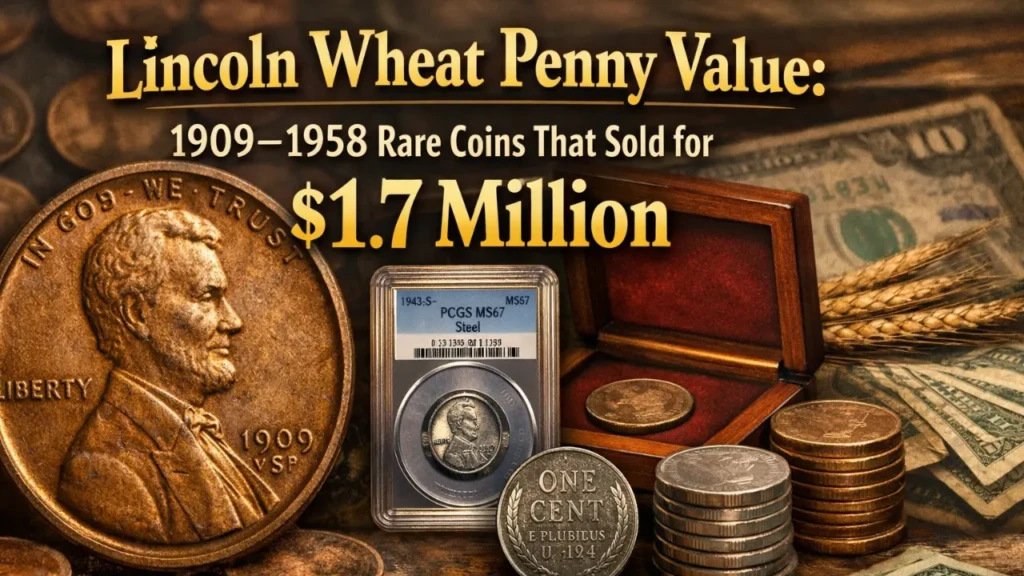
The Lincoln Wheat Penny is one of the most famous and widely collected coins in American history, known for its long circulation period, iconic design, and strong demand among collectors. First introduced in 1909 in honor of Abraham Lincoln’s 100th birthday, this coin quickly became a symbol of American heritage and remains highly valued today, both historically and financially.
History of the Lincoln Wheat Penny
The Lincoln Wheat Penny was introduced in 1909 when the U.S. Mint decided to replace the Indian Head cent with a new design honoring President Abraham Lincoln. This was the first American coin to feature the likeness of a real historical figure rather than an allegorical figure. Designed by sculptor Victor David Brenner, the coin represented a significant departure in American coinage and was continuously minted until 1958, making it one of the longest-running coin series in American history.
Design and Appearance
The obverse of the Lincoln Wheat Penny features a detailed portrait of Abraham Lincoln facing right, along with the inscriptions “IN GOD WE TRUST,” “LIBERTY,” and the year of mintage. The reverse depicts two stalks of wheat flanking the words “ONE CENT” and “UNITED STATES OF AMERICA.” The wheat design symbolized prosperity and national growth, which is why collectors often refer to this coin as the “Wheat Cent.”
Mintage Years and Production
Lincoln Wheat Pennies were minted from 1909 to 1958 at three major U.S. mints: Philadelphia, Denver, and San Francisco. Over 25 billion coins were produced during this period, making them widely used in everyday transactions for decades. Some years saw exceptionally high production, such as 1944 with over 1.4 billion coins minted, while other years had limited production, making those coins rare and valuable today.
Rare and Valuable Wheat Pennies
Not all Lincoln Wheat Pennies are common. Certain years and mint marks are quite rare and can be worth thousands or even millions of dollars. The most famous is the 1943 copper Wheat Penny, mistakenly struck on copper instead of steel during World War II, which has sold for over $1.7 million at auction. Other valuable examples include the 1909-S VDB, the 1914-D, and the 1922 No D, which command high prices due to their limited mintage and collector demand.
Metal Composition and Weight
The Lincoln Wheat Penny was originally composed of 95% copper and 5% zinc and tin, giving it a solid reddish-brown color. During World War II in 1943, the U.S. Mint temporarily switched to using zinc-coated steel to conserve copper for the war effort. These steel pennies are magnetic and have a silver-gray color, making them easy to identify. A standard copper Wheat Penny weighs approximately 3.11 grams, while the steel cents weigh approximately 2.7 grams.
Collector Demand and Market Value
Today, Lincoln Wheat Pennies are among the most widely collected coins in the world. Millions of people search through old jars, inherited collections, and bankrolls hoping to find rare dates. Common Wheat Pennies typically sell for 5 to 20 cents, while coins in better condition can fetch several dollars. Rare editions in mint condition can range from a few hundred dollars to well over a million dollars, depending on their rarity, grade, and demand.
How to Identify a Valuable Wheat Penny
To identify a valuable Lincoln Wheat Penny, collectors examine the year, mint mark, condition, and metal type. Mint marks appear below the year and include “D” for Denver and “S” for San Francisco, while Philadelphia coins have no mark. Coins with sharp detail, minimal wear, and original luster command significantly higher prices. A magnet can be used to identify the 1943 steel penny and help detect the rare copper versions.
Investment and Long-Term Potential
Lincoln Wheat Pennies are not only historical artifacts but also valuable long-term investment assets. Over the past 50 years, the value of rare Wheat Pennies has steadily increased due to limited supply and growing global interest in coin collecting. As fewer high-grade examples remain in circulation, prices continue to rise, making them attractive to both collectors and investors who wish to preserve American history while building wealth.

Cultural Impact and Popularity
The Lincoln Wheat Penny holds a special place in American culture. It was carried by soldiers during World War II, used for everyday purchases during the Great Depression, and remains a nostalgic symbol for generations. Even today, schools use Wheat Pennies to teach students about history, economics, and numismatics, keeping the legacy of this iconic coin alive.