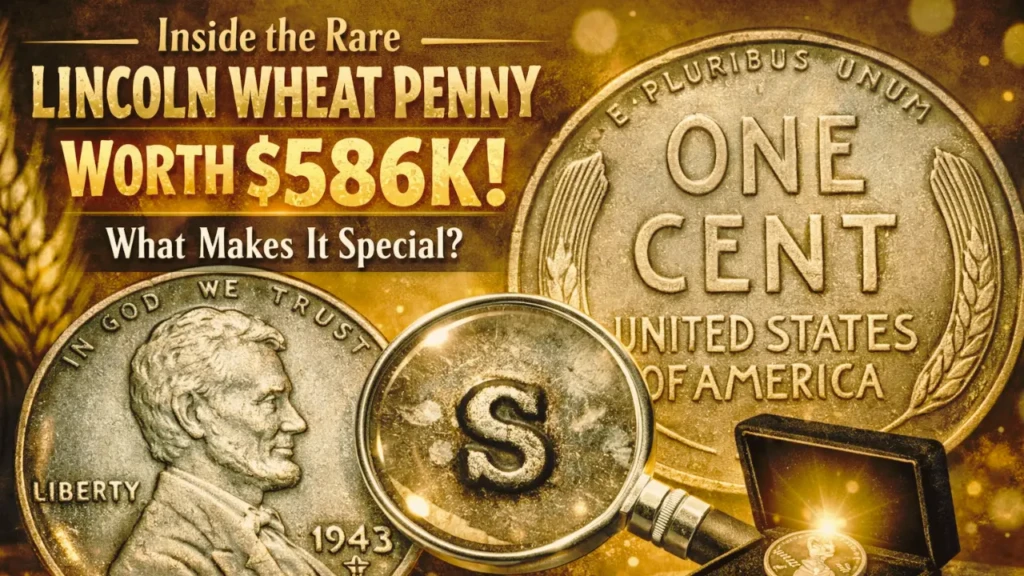
Rare Lincoln Wheat Penny Worth $586K | The $586,000 rare Lincoln Wheat Penny is not just a coin; it represents a pinnacle in the field of U.S. numismatics and coin collecting. This particular Wheat Penny stands out due to its rarity, historical significance, and condition. Unlike most Wheat Pennies that sell for modest prices, this coin fetched a staggering $586,000 at auction, making it one of the most valuable pennies ever sold in the United States.
The coin’s value stems from a combination of its low mintage year, unique error characteristics, and near-perfect preservation. Collectors and investors alike keep a close eye on such coins, as they represent both historical and monetary value. While most Lincoln Wheat Pennies are readily available and inexpensive, a select few rise above the rest and command the attention of serious collectors.
A Brief History
The Lincoln Wheat Penny was first issued in 1909 to commemorate the 100th birthday of President Abraham Lincoln. Designed by Victor David Brenner, the coin replaced the Indian Head Penny and became one of the longest-running designs in U.S. history. For over thirty years, from 1909 to 1958, the coin featured two stalks of wheat on the reverse, giving it its nickname.
During those decades, over 60 billion Wheat Pennies were minted, making most of them common and rarely worth more than a few dollars. However, certain years and mint marks were produced in much smaller quantities or contained significant errors, dramatically increasing their value. The coin that sold for $586,000 exemplifies one of these rare variations that collectors highly prize.
The Error That Changed Everything
The rare $586K Lincoln Wheat Penny fetched this astronomical price due to a specific mint error, one of the primary reasons certain coins become exceptionally valuable. Mint errors can occur when blanks are not properly fed into the striking press, dies are misaligned, or there are irregularities in the planchet. In the rarest cases, these errors result in visually striking anomalies that are highly sought after.
The specific error on this penny created a unique and easily identifiable difference from standard issues. Collectors value such anomalies because they are unpredictable, impossible to replicate, and limited by the circumstances of their creation. The scarcity of coins with this precise error makes them a treasure for any serious numismatist.
Auction Records and Demand
In a historic sale, the rare $586K Lincoln Wheat Penny was sold at a major American auction, where bidders from around the world competed to acquire it. Auction records indicate that demand for rare coins of historical significance is consistently increasing, especially for those with documented histories and certification from reputable grading services.
The final price reflects more than just rarity; it demonstrates the fierce competition among collectors and investors who view rare coins as an alternative asset class. Coins like this Wheat Penny are valued not only for their beauty and history but also for their long-term investment potential. Over the past decade, the value of rare collectible coins has outpaced inflation, attracting a new generation of numismatists.
The Importance of Condition and Grading
Condition is paramount in coin collecting, and the $586K rare Lincoln Wheat Penny was graded at the highest level by a leading third-party grading company. Coins are valued based on factors such as surface preservation, luster, strike quality, and lack of wear. A coin in near-perfect or perfect condition can command a significantly higher price than coins of the same date in poorer condition.
Grading services assign numerical grades on a 70-point scale, with anything above 60 considered exceptional for coins over 80 years old. This penny’s grade placed it in an elite category, making it one of the few examples to meet such stringent standards. Collectors often say that the difference between a grade of 60 and a grade of 70 can be the difference between a coin worth hundreds of dollars and one worth millions of dollars.
What This Means for Collectors
For average collectors, the sale of a rare $586K Lincoln Wheat Penny underscores the importance of carefully examining and preserving coins. Even seemingly common coins can fetch surprising prices if they possess a rare characteristic or error. Many collectors are now spending more time scrutinizing their Wheat Pennies with magnifying glasses, searching for doubling, off-center strikes, or other unusual features.
This record-breaking sale also highlights the role of proper documentation and certification. Coins without grading service certification typically sell for significantly less because buyers cannot confidently verify their condition or authenticity. Consequently, collectors hoping to sell high-value coins often invest in professional grading to maximize their returns.

The Future of Wheat Penny Collecting
The spectacular sale of the $586K rare Lincoln Wheat Penny could spark renewed interest in American pennies among both seasoned and new collectors. The Lincoln Wheat Penny series spans over five decades, offering numerous collecting opportunities based on dates, mint marks, and varieties.
While few coins will ever reach six-figure prices, many could appreciate in value, especially if found in excellent condition or possessing a unique error. As interest in numismatics continues to grow, Wheat Pennies remain a cornerstone for collectors seeking to connect with American history through individual coins.
Final Thoughts
The $586K rare Lincoln Wheat Penny is a testament to the enduring appeal of coin collecting in the United States. Its remarkable auction result showcases the interplay of history, rarity, condition, and collector passion. Whether you’re a seasoned numismatist or a curious new collector, the story of this extraordinary penny demonstrates that remarkable treasures can be found in the most unexpected places, even in a humble penny.