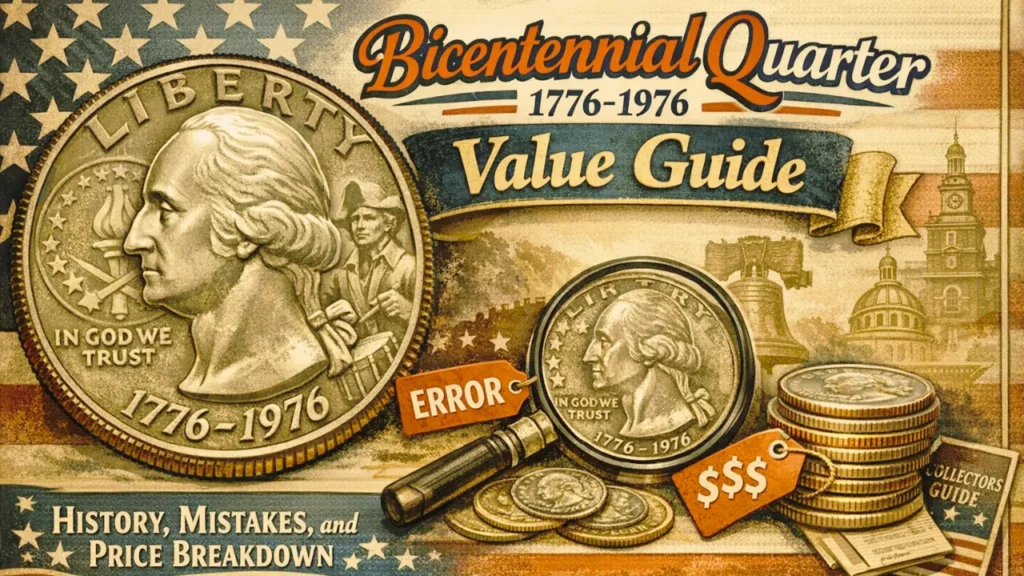
Bicentennial Quarter 1776-1976 Value Guide | The Bicentennial Quarter 1776-1976 is one of the most well-known U.S. commemorative coins ever minted. It was issued to honor the 200th anniversary of American independence, a major milestone in the country’s history. Instead of a single year, these quarters feature the double date “1776-1976,” immediately distinguishing them from regular Washington quarters. The U.S. Mint produced these coins in very large numbers, and millions were released into circulation. Due to this high mintage, most Bicentennial quarters are still worth face value today. However, certain versions, mint marks, and special conditions can significantly increase their value.
Design and Historical Background
The Bicentennial Quarter features the familiar portrait of George Washington on the obverse, but the reverse design was changed for this special edition. Instead of the traditional eagle, the coin features a colonial drummer with a torch surrounded by thirteen stars. This reverse design captures the spirit of the American Revolution and the original Thirteen Colonies. The artwork was selected through a national design competition, making it a unique example of history made collectively. Production began in 1975 and continued until 1976, although all coins bear a double date. This helped ensure that there were enough coins available for public circulation during the Bicentennial celebrations across the country.
Mint Marks and Composition
The Bicentennial Quarter features three U.S. They were produced at the Mint facility. Each mint produced coins with slightly different characteristics that influence collector interest. Philadelphia coins have no mint mark. Denver coins have a “D” mint mark. San Francisco coins have an “S” mint mark and were primarily produced as proof or silver-clad versions. Most circulating Bicentennial quarters are made of copper-nickel clad. Some San Francisco issues were made with 40% silver, giving them a higher intrinsic metal value and greater collector demand.
Bicentennial Quarters 1776-1976 Value Overview
The value of Bicentennial quarters depends on condition, mint mark, and composition. Circulated coins generally remain close to face value, while uncirculated and proof examples can fetch higher prices.
Here’s a general value overview based on general market observations:
| Type | Condition | Estimated Value (USD) |
|---|---|---|
| Philadelphia (No Mint Mark) | Circulated | $0.25 – $0.50 |
| Denver (D) | Circulated | $0.25 – $0.50 |
| Philadelphia (No Mint Mark) | Uncirculated | $1 – $3 |
| Denver (D) | Uncirculated | $1 – $3 |
| San Francisco (S) Proof Clad | Proof | $4 – $8 |
| San Francisco (S) Silver Proof | Proof | $8 – $15 |
| San Francisco (S) Silver Uncirculated | Uncirculated | $6 – $12 |
These values can vary depending on demand and the coin’s overall condition. Coins with a bright luster, a clean surface, and no damage are more desirable.
Grading and the Impact of Condition
Grading plays a significant role in determining the value of a Bicentennial Quarter. Even small differences in condition can significantly affect the price. A circulated coin may show wear on Washington’s hair, the drummer’s details, and the rim. Uncirculated coins retain sharp details and the original mint shine. Proof coins have mirror-like fields and frosted designs. Professional grading services assign numerical grades such as MS65 or PR69. Higher grades generally yield higher resale values, especially for Proof and Silver examples.
Information About Silver Bicentennial Quarters
Some Bicentennial quarters contain up to 40% silver and were never intended for daily circulation. They were sold in special collector sets. Silver versions weigh more than standard clad quarters and often have a softer, slightly gray appearance. Their value is determined by both collector demand and the current price of silver. Due to their lower production rate than the regular clad versions, silver Bicentennial quarters are a more desirable choice among collectors.
Common Mistakes and Varieties
Mistakes can significantly increase the value of Bicentennial quarters. These mistakes occur during the minting process and are often very minor. Examples include double die errors, off-center strikes, clipped planchets, and missing clad layers. Some of these misdeeds have sold for hundreds of dollars, depending on severity and condition. Careful inspection under magnification can help identify potential errors. If any unusual features are found, professional authentication is recommended.
How to Identify a Valuable Coin
Start by checking the mint mark and overall condition. Look for sharp details, a shiny surface, and minimal wear. Next, weigh the coin. A heavier-than-normal quarter may indicate a silver coin. Finally, check for unusual features such as doubling or incorrect design. Using a digital scale and magnifying glass can significantly improve accuracy when examining coins.
Collecting and Selling Tips
Keep Bicentennial quarters in a protective holder to protect them from scratches and oxidation. Avoid cleaning the coins, as this can reduce their value. When selling, compare recent market prices from reputable coin dealers and auction platforms. For high-value examples, professional grading can help maximize selling prices. Collectors often prefer certified coins because they provide authenticity and condition assurance.
Long-Term Market Outlook
Bicentennial quarters will remain popular due to their historical significance and nostalgic appeal. Although most common examples will not be very valuable, high-grade and silver versions should remain in steady demand. Their large mintage limits sudden price increases, but strong collector interest maintains consistent activity in the market. For beginners, Bicentennial quarters are an affordable way to start a U.S. coin collection with meaningful historical context.